Data governance vs AI governance: who answers when AI gets it wrong?

By A2FF DigitalPublished 11 min read

First published version.

In short

  1. Data governance asks whether you can trust what goes into AI. AI governance asks who answers for what comes out.
  2. The PCPD notes that poor data governance "may not be the sole cause" of generative AI's "hallucinations", so clean data does not make AI right.
  3. In our view, every AI workflow needs one named owner, a level of human checking set by risk and a record of each run. A five-role owner map shows who does what.

This is part of our work on AI Solutions.
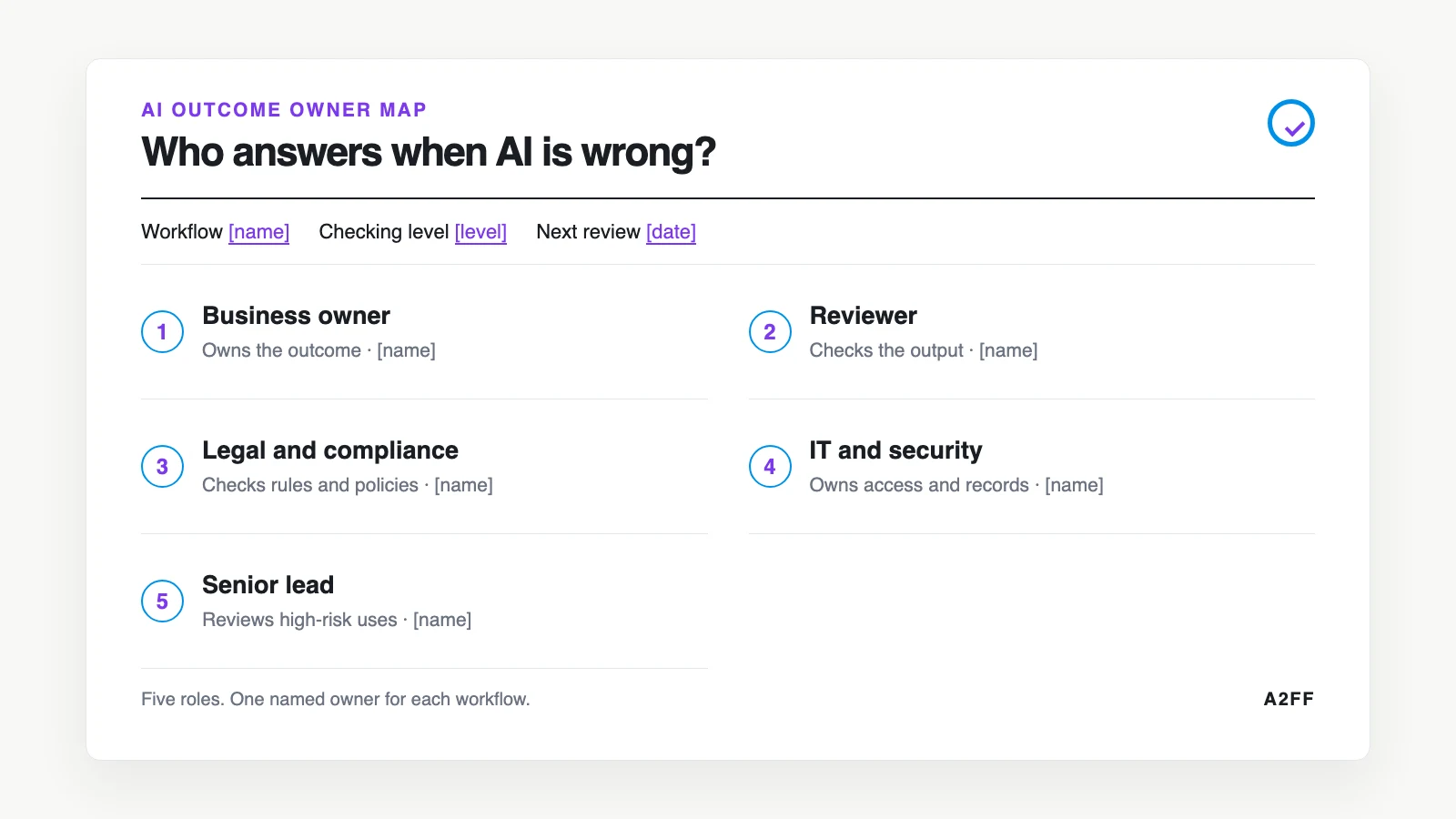
Five-role owner map showing who answers for each part of an AI outcome.

Data governance asks whether you can trust what goes into AI. AI governance asks who answers when the output is wrong. Clean data does not settle the second question: the Office of the Privacy Commissioner for Personal Data (PCPD) notes that poor data governance "may not be the sole cause" of generative AI's "hallucinations". The Ethical AI Framework from the Digital Policy Office (DPO) says there should be "a clearly identifiable accountable party". In our view, every AI workflow needs one named owner, a level of human checking set by risk and a record of each run.

As of 5 October 2026: we read every document cited below on the issuer's own page and describe what it says. This is not legal advice; your legal adviser can tell you which documents apply to your company.

What is the difference between data governance and AI governance?

Data governance makes sure what goes into AI can be trusted; AI governance makes sure someone answers for what comes out.

The PCPD says in its Model Framework of June 2024 that "Good data governance goes hand in hand with governance for trustworthy AI", and warns that poorly managed data may cause a "garbage in, garbage out" problem. It also says, in a footnote, that poor data governance "may not be the sole cause" of generative AI "hallucinations".

So a company can have clean data and still publish a wrong answer. In our view, someone has to own that output.

Data governance and AI governance

Data governance

  • What it protects: The input: data quality, privacy and where data came from
  • The question: Can we trust what goes in?
  • Usually run by: Data and IT teams
  • Where it is recorded: Data catalogue, access logs
  • What goes wrong without it: Wrong or unlawful data goes in

AI governance

  • What it protects: The output: decisions and content once AI has produced them
  • The question: Who answers when the output is wrong?
  • Usually run by: The business owner of the workflow, with reviewers
  • Where it is recorded: Approvals, run records, reviews
  • What goes wrong without it: A wrong output goes out and nobody owns it
A2FF's view, built on the PCPD's Model Personal Data Protection Framework, June 2024 (paragraphs 10 and 39, footnote 23).

Who answers when AI gets something wrong?

Hong Kong's official guidance puts it on the organisation that uses the AI, not on the tool. In our view, that means a person the company names in advance.

The DPO published its Ethical Artificial Intelligence Framework, Version 2.0, in December 2025. It says: "Organisations are responsible for the actions, decisions, and outputs of AI systems they develop, deploy, or use." It also says there should be "a clearly identifiable accountable party, be it an individual or an organisational entity", and that roles should be organised so "the ultimate decision-making authority for the AI and data activity has been assigned". The framework was written for government bureaux and departments; the DPO says it applies to other organisations in general.

Some regulators, such as the Securities and Futures Commission (SFC), say it for their own sector. The SFC, in its circular of 12 November 2024 on generative AI language models, tells licensed corporations that they "remain accountable for their output regardless of the risk mitigation measures adopted". That circular is addressed to licensed corporations only.

In our view, "the organisation" is not a name, so choose the person before launch rather than after the first mistake. For the laws and regulator rules themselves, see our map of Hong Kong's AI rules.

Who owns which part of an AI outcome?

In our owner map, one business owner answers for the workflow, and four others each own a part of it.

The roles come from official text: the PCPD's Model Framework gives examples of roles and responsibilities, and the DPO recommends a "three line of defence model" where feasible. The grouping into five is ours, and so is the idea that the business owner, not IT, is the first row.

  1. Business owner (the head of the team whose work the AI does). The business owner owns the outcome: chooses what the AI is used for, sets the checking level, approves the launch and answers when the output is wrong. This person acts before launch and on every reported problem. Basis: the DPO's "accountable party" and "ultimate decision-making authority" lines; giving this role to the business owner is our view.
  2. Reviewer (a named person). The reviewer checks the output at the checking level set for the workflow (every output in the loop, spot checks in command; the next section explains these levels) and approves, corrects or stops it. The PCPD says human reviewers "should focus on reviewing the decisions and output of AI systems". This is PCPD guidance.
  3. Legal and compliance. Check which laws, regulator rules and internal policies apply, before launch and when anything changes. The PCPD says they "should focus on ensuring compliance with relevant laws and regulations (including data protection laws) as well as internal policies". This is PCPD guidance.
  4. IT and security. IT and security own the tool, its access rights, the data going in and the run record. The PCPD lists "customisation, implementation, monitoring and maintenance of AI solutions" and "the organisation's internal data governance processes" as technical staff's focus, and its agentic AI guidance adds minimum access rights and logging. This is PCPD guidance.
  5. Senior lead (a senior executive or a small committee). The senior lead owns the list of AI uses, reviews and monitors the high-risk ones and runs the regular review. The DPO's third line of defence is "reviewing, advising and monitoring of high-risk AI applications". This is DPO guidance.

On the card, name the people: "Assigned people: Business owner [name] · Reviewer [name] · Legal and compliance [name] · IT and security [name] · Senior lead [name]".

Who owns which part of an AI outcome

Workflow: [name] · Checking level: [in the loop / in command / out of the loop] · Next review: [date]
Assigned people: Business owner [name] · Reviewer [name] · Legal and compliance [name] · IT and security [name] · Senior lead [name]

  1. 1 Business ownerOwns: The outcome: chooses what the AI is used for, sets the checking level, approves the launch, answers when it is wrongActs when: Before launch; on every reported problemLabel: Our view, built on the DPO's accountable party
  2. 2 ReviewerOwns: The output, at the level set: approve, correct or stopActs when: Every run in the loop; spot checks in commandLabel: PCPD guideline
  3. 3 Legal and complianceOwns: Which laws, regulator rules and policies applyActs when: Before launch; when a rule or the use changesLabel: PCPD guideline
  4. 4 IT and securityOwns: The tool, its access, the data going in, the run recordActs when: At set-up; whenever access or the tool changesLabel: PCPD guideline (Model Framework; agentic AI guidance)
  5. 5 Senior leadOwns: The list of AI uses, review and monitoring of high-risk uses, the regular reviewActs when: High-risk launches; the set reviewLabel: DPO guideline
PCPD, Model Personal Data Protection Framework, June 2024 (paragraph 20); PCPD, Protecting Personal Data Privacy in the Use of Agentic AI, 25 August 2026 (recommendations 6(d), 6(f)); DPO, Ethical AI Framework, Version 2.0, December 2025. The grouping into five roles and the business owner row are A2FF's view.

Staff who use the AI follow the company's AI policy. The PCPD says business and operational personnel "should use AI in accordance with the policies and procedures of the organisations". For what that policy should say, see the staff policy in our shadow AI article.

How closely should a person check each AI output?

By risk: the PCPD describes three levels, from AI acting alone for minimal risk to a person keeping control of the decision for high risk.

  • Human in the loop. For a high-risk AI system, "human actors retain control of the decision-making process". The PCPD's higher-risk examples include "Assessment of job applicants, evaluation of job performance or termination of employment contracts". For AI agents, its August 2026 guidance says to use this approach where decisions may significantly affect individuals, including "high-stakes, irreversible or atypical actions, such as approving the transmission of personal data to third parties".
  • Human in command. When neither of the other two fits, for example when risks are "non-negligible" or in the loop is not "cost-effective or practicable", the PCPD says organisations may consider this level: human actors "make use of the output of the AI system and oversee the operation of the AI system and intervene whenever necessary".
  • Human out of the loop. The PCPD says an AI system with "minimal or low risks" may take this approach.

In our view, the checking level belongs next to each workflow in the owner map. Our own examples: internal meeting notes can run out of the loop; a marketing draft a person edits fits in command; anything about a named customer or employee belongs in the loop.

How closely a person checks an AI output

  1. 1 Human out of the loopPCPD: "An AI system with minimal or low risks may take a "human-out-of-the-loop" approach"Example (A2FF's): internal meeting notes
  2. 2 Human in commandPCPD: people "make use of the output", "oversee the operation" and "intervene whenever necessary"Example (A2FF's): a marketing draft a person edits
  3. 3 Human in the loopPCPD: "human actors retain control of the decision-making process"Higher-risk example (PCPD, Figure 12): assessment of job applicants

PCPD examples are marked PCPD; the other examples are ours.

PCPD, Model Personal Data Protection Framework, June 2024 (paragraph 32, Figures 11 and 12), redrawn by A2FF.

How do you show who did what after a mistake?

Keep a record of each AI run, give staff a way to report a problem and review the workflow on a set rhythm.

The PCPD's agentic AI guidance of 25 August 2026 suggests logging that records "AI agents' operations, operation timestamps, tools used, data accessed, and reasoning of decisions". The Model Framework lists, among the elements an AI governance structure "may include", "Effective internal reporting mechanisms for reporting any system failure or raising any data protection or ethical concerns". In its 2026 compliance checks, the PCPD's recommendations include "Conduct regular audits", and 15 of the 24 organisations that collected or used personal data through AI (approximately 63%) conducted internal audits and/or independent assessments on a regular basis.

In our view, the record lets the owner answer "what happened, and who checked it?" after a mistake.

A run record, one line per AI run

Example, not a real run

Date and time5 Oct 2026, 09:30
WorkflowInternal meeting summary
OwnerOperations lead
What the AI drew onMeeting notes
What it producedDraft summary
Checking levelOut of the loop
Who checked itMeeting organiser
Decision: used, corrected or stoppedCorrected
Reported problem, if anyAction owner omitted; fixed before use
Template by A2FF. Logging contents: PCPD, Protecting Personal Data Privacy in the Use of Agentic AI, 25 August 2026 (recommendation 6(f)).

Frequently asked questions

Sources

As of 5 October 2026: we read each source below on the issuer's own page that day.

  1. PCPD (Office of the Privacy Commissioner for Personal Data), "Artificial Intelligence: Model Personal Data Protection Framework". June 2024. https://www.pcpd.org.hk/english/resources_centre/publications/files/ai_protection_framework.pdf
  2. Digital Policy Office (DPO), "Ethical Artificial Intelligence Framework", Version 2.0. December 2025. https://www.digitalpolicy.gov.hk/en/our_work/data_governance/policies_standards/ethical_ai_framework/doc/Ethical_AI_Framework_en.pdf
  3. DPO, "AI and Data Ethics" page. Last revised 30 June 2026. https://www.digitalpolicy.gov.hk/en/our_work/data_governance/policies_standards/ethical_ai_framework/
  4. SFC (Securities and Futures Commission), "Circular to licensed corporations: Use of generative AI language models". 12 November 2024. https://apps.sfc.hk/edistributionWeb/api/circular/openFile?lang=EN&refNo=24EC55
  5. PCPD, media statement on compliance checks on 60 organisations. 19 May 2026. https://www.pcpd.org.hk/english/news_events/media_statements/press_20260519.html
  6. PCPD, "Artificial Intelligence: Model Personal Data Protection Framework: Protecting Personal Data Privacy in the Use of Agentic AI". 25 August 2026. https://www.pcpd.org.hk/english/resources_centre/publications/files/pcpd_use_of_agentic_ai.pdf
  7. Chief Executive of the HKSAR, Policy Address 2026, "Risk Governance", paragraph 123(v). 16 September 2026. https://www.info.gov.hk/gia/general/202609/16/P2026091600264.htm
  8. DPO, "Hong Kong Generative Artificial Intelligence Technical and Application Guideline", Version 1.1. December 2025. https://www.digitalpolicy.gov.hk/en/our_work/data_governance/policies_standards/ethical_ai_framework/doc/HK_Generative_AI_Technical_and_Application_Guideline_en.pdf
Talk to us about AI Solutions

Building the owner map into your AI work

A2FF agrees the owner map with your team, then sets the checking level and builds the run record for each workflow. Whoever handles legal and compliance for you confirms the result.

Talk to us about AI Solutions
Share this article LinkedIn Facebook
All articles
Scroll to Top