First published version.
This is part of our work on AI Solutions.
In the Hong Kong Internet Registration Corporation's (HKIRC) 2026 survey of 806 Hong Kong organisations, 94% said staff use AI at work, yet 63% had no AI policy. Discouraging or banning AI does not close that gap: among the organisations that discourage or ban AI at work, 69% said staff use it anyway. In our view, a short list of approved tools and a one-page policy with a named owner and a review date works better. Start by finding the tools already in use. Then write the six lines your policy page needs.
For the rules set by law and by regulators, see our map of Hong Kong's AI rules.
As of 5 October 2026: we read every document cited below at the issuer's own page.
Very common: in HKIRC's 2026 survey, 94% of organisations said staff use AI at work, and among those that encourage or allow it, 49% said staff had used AI tools the organisation had not approved.
Shadow AI means staff using AI tools their organisation has not approved. HKIRC surveyed 806 organisations in April and May 2026. They include schools and NGOs as well as companies, and the survey does not claim to represent all of Hong Kong. Across all 806, 63% had not set an AI policy, and 68% arranged no AI training. HKIRC's report gives the 49% for the organisations that encourage or allow AI use, about 92% of the 806. Its press release gives the same figure without that limit, so we use the narrower reading.
In our view, the risk is that material leaves the company with no record, and nobody checks what comes back.
Because staff use AI anyway: among organisations that discourage or ban it at work, 69% said staff use AI tools for their work.
That group is small: HKIRC says 8% of the 806 discourage or ban AI (7% discourage it, 1% ban it outright), and does not print how many organisations that is. The most common reason these organisations gave for discouraging or banning AI was fear of data leaks (45% of that group). Separately, among the organisations that encourage or allow AI, a different group, 45% said staff had used personal devices for AI work.
In our view, a ban pushes AI onto personal phones and free accounts, where the company sees nothing. An approved route keeps the work where someone can check it.
Ask before you buy anything: find out who uses which tool, for which work and with which material, then turn the answers into your approved tools list.
HKIRC's own advice is to take stock of the AI tools in use and build an approved list (our translation of 「盤點現行AI工具,建立獲批使用清單」). The PCPD's Model Framework (June 2024, para 14) names "Establishing an AI inventory to facilitate the implementation of governance measures". Neither tells you how to start.
In our view, the place to start is a short staff survey, then expense claims and browser extensions, before any detection software. The survey needs only the four questions above. Then sort each tool into approved, approved with limits, or not allowed.
| Who | Which tool | Which work | Which material |
|---|---|---|---|
| Sales team (example) | A free AI writing tool | Drafting follow-up emails | Client names and email addresses |
Sort each row: approved, approved with limits, or not allowed.
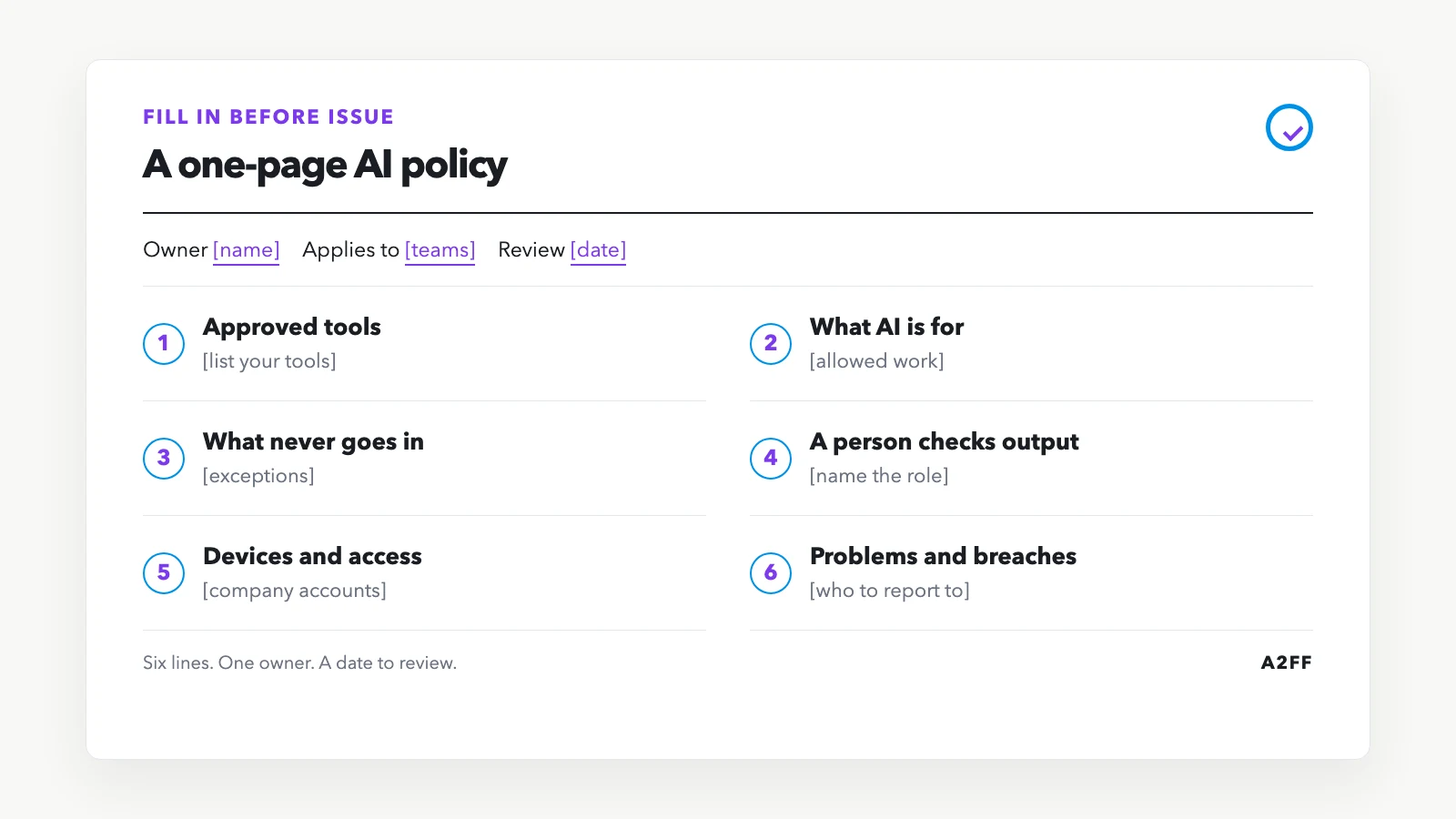
Six things on one page: the approved tools, the work AI may and may not do, what must never go in, who checks the output, which devices and accounts, and how to report a problem.
The card below is a template: complete the brackets before you issue it.
Owner: [name] · Applies to: [whole company or named teams] · Next review: [date]
We built the six lines from the headings of the PCPD's March 2025 checklist on staff use of generative AI; the grouping into six is ours. On input, the checklist says to give "clear instructions on the types and amounts of information that can be inputted into Gen AI tools and the types of information that cannot be inputted (e.g., personal, confidential, proprietary or copyrighted data)". On output, it says to stress "the need for employees to verify the information provided by AI, including proofreading and fact-checking". Line 5 draws on HKIRC's advice to use AI through company devices and networks, and on the PCPD's August 2026 agentic AI guidance, which recommends granting AI agents "the minimum access rights necessary to complete the tasks at hand".
In the PCPD's 2026 checks, 17 of the 24 organisations that used personal data through AI (about 71%) had internal policies or guidelines for staff use of generative AI. Those 24 came from the 60 organisations the PCPD checked, so this is not a sample of Hong Kong companies and not comparable with HKIRC's figures.
Complete the brackets before you issue it.
One named person senior enough to approve a new tool owns the policy, legal and IT check it, and the owner reviews it on a set date and whenever the tools, the guidance or the work change.
The advice on who owns it is our view. The review date has support: the PCPD's checklist says organisations "should regularly review and update the relevant policies or guidelines as required to accommodate operational and technical changes". The PCPD's 2026 check results repeat the advice to "regularly review and update" such policies. In our view, a good trigger for an early review is staff starting to use AI agents that act on their behalf.
The policy only works if staff know about it. The owner tells staff where the policy lives, trains them on it, and gives them a place to ask questions. The checklist's practical tips also name a support team and a feedback mechanism, so staff know who to ask and can say when a rule does not fit their work.
A staff member pastes a client list into a free AI tool on a personal phone to draft emails. The tool is not approved, the material has left the company and nobody checks the result. This example is hypothetical.
The PCPD's checklist presents a staff AI policy as "a matter of good practice". Whether the law requires one for your company is a question for your legal adviser. The checklist says it "aims to help organisations develop internal policies or guidelines" and that its information is "for general reference only". In its 2026 compliance check results, the PCPD's recommendations include "Establish internal policies or guidelines" for staff use of AI at work.
In our view, yes, and one page is enough to start. HKIRC found that small and medium-sized firms (its 「中小企」 group) were less likely than large firms to have a policy: 75% had none, against 43% of large firms. Across all sizes, the most common reason HKIRC reports for having no policy or training was that the organisation had no need for one yet (43%, a separate figure from the 43% of large firms).
As of 5 October 2026: each source below was read at the issuer's page on that date.
A2FF takes stock of the AI tools in use, drafts the one-page policy with the owner you name, and trains your teams. Whoever handles legal and compliance for you confirms the final text.
Talk to us about AI Solutions