First published version.
This is part of our work on AI Solutions.
When Hong Kong customers complained to the Consumer Council about chatbots, the key complaints its 2022 study lists were stock answers, no answer to their own case, and no person even when one was asked for. In our view, a company should plan when its AI agent passes a customer to a person before it plans what the agent answers. In our own check on 6 October 2026, eight public chatbots offered a person in 46 of 144 conversations. Ours is a small snapshot, not a measure of Hong Kong or of any company.
As of 6 October 2026: we read every document cited below on the issuer's own page and describe what it says. This is not legal advice.
In the Consumer Council's study (survey 2021, report 2022), the key complaints about chatbots were stock answers, no answer to the customer's own case, and no person even when one was asked for.
The Council's online survey of 1,219 Hong Kong residents (18 October to 2 November 2021) covered AI in e-commerce. Of them, 75% had used chatbots. "Only 38% of the users felt improvement in their shopping experience with chatbots", and "merely 21% preferred AI to direct human contact". Among the complaint cases about chatbots that the Council received, the key complaints were "Continuously providing robotic and standard answers that can be found on the frequently-asked question (FAQ) page", "Being slow in response", "Lacking real persons' involvement even when requested" and "Failing to answer case-specific questions". In our view, three of the four are about the moment the chatbot runs out of answers, so design that moment first.
E-commerce only. Survey 18 October to 2 November 2021.
The ones whose answer is in approved company material and is the same for every customer; the rest go to a person.
The Privacy Commissioner's office (PCPD) says in its Model Framework of June 2024 that a generative AI chatbot "generating direct responses to customer enquiries" is more likely to have a significant impact on individuals than a tool "used for internal translation". In the HKMA's GenA.I. Sandbox report of 31 October 2025, one bank's website chatbot was told to "Mandate the use of datastore before answering any query" and to "Define the precise conditions under which a query should be 'out-of-scope'". That is one participant's practice, not a requirement.
In our view, write the answer list in three groups, with our examples: the AI answers (product facts and how-to steps); the AI answers and offers a person (a return policy as written); a person answers (anything about the customer's own order, account or money). Name the source document for each answer, so the agent never answers from general knowledge; that approved material can be kept as a knowledge base, as in Tandra AI.
Our check also asked each chatbot for its customer service hotline hours. In 10 of the 24 conversations the reply gave hours or a hotline number. Set against the organisation's own public pages, 3 of those 10 matched, 5 matched only in part (most gave the number without the hours) and 2 gave the hours of a different service. The other 14 did not give the hours or number asked for, or did not reply.
How do I set up the product?
What does the plan include?
What is your return policy?
Can I change my delivery address?
(policy as written, with a person for the case)
Why was my account charged twice?
Can you make an exception for me?
When the customer asks, when the answer is not in approved material, and when money, an account, a complaint, a decision or unneeded personal data is involved.
Regulators set the bar for their own sectors. The HKMA's circular of 19 August 2024, addressed to authorized institutions (banks), says that during the early stage of deploying customer-facing generative AI, customers should have "the option to opt out of using GenAI and request human intervention on GenAI-generated decision at their discretion as far as practicable". The PCPD's guidance of June 2024 says that where an AI system's output "may have a significant impact on individuals", organisations should "to the extent possible, provide channels for individuals to provide feedback, seek explanation, and / or request human intervention". In our view, these are a useful bar for any company with a customer chatbot. The PCPD framework is guidance, not law.
The Consumer Council tested the request itself. In its chatbot review (Q2 2021 and Q2 2022), it typed "I would like to talk to a human agent" into six built-in chatbots. Two gave a direct and relevant answer or a sensible follow-up question in English, and four did in Chinese; the other two in Chinese could not answer correctly, though a menu option for human agents existed. For a customer charged twice who asked for a refund, none did so in English.
Our check repeated the wording. On 6 October 2026 we put six everyday enquiries to eight public chatbots on Hong Kong websites in five sectors, each in English, written Chinese and Cantonese typed with English (144 conversations). We stopped each one when a person was offered and never accepted a transfer. Asked to talk to a person, 10 of the 24 conversations offered one in the reply. Four of the eight chatbots offered a person in at least one form; four never did when asked. In 9 of the 24, the chatbot asked what the enquiry was about and offered no person. We counted offers in the reply, not in an opening menu.
We sorted first replies into the Council's own groups. On the double-charge question in written Chinese, 3 of our 8 gave a direct and relevant answer or a sensible follow-up (one of the Council's six did), and 3 of 8 offered a person. On the forgotten-password question, 6 of our 8 did so in English and 6 of 8 in written Chinese (3 of the Council's six in each language). The samples differ (six e-commerce chatbots then, eight chatbots in five sectors now) and different people judged the replies, so we draw no trend. Ours is a small snapshot, not a measure of Hong Kong or of any company.
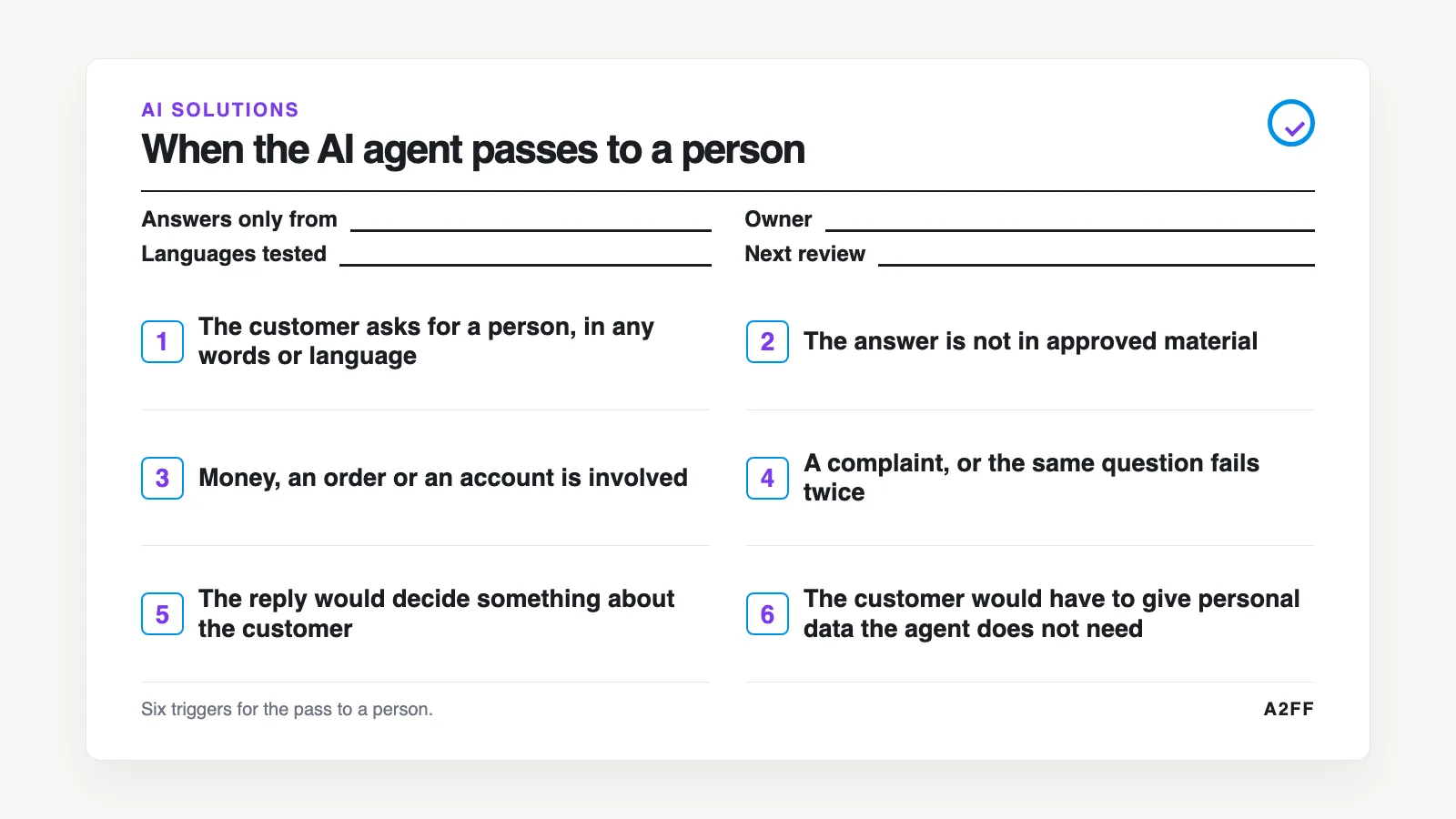
The card below sets out our six triggers. The "twice" in trigger 4 is our view only: none of the sources says how many failed tries should trigger a pass. On trigger 6, the PCPD's tips for users of AI chatbots (4 August 2025) say "Refrain from sharing your own personal data and others' personal data"; in our check, no chatbot asked for personal data in chat. In our view, at every pass the person should see the conversation so far.
And at every pass: the person can see the conversation so far (our view).
That it is AI, what it can help with, and, at the pass, that a person is taking over with the conversation so far.
The Securities and Futures Commission (SFC) tells licensed corporations, in a circular of 12 November 2024, that where an AI language model is used in the client interface they "should provide prominent disclosures in the user interface that they are interacting with AI rather than humans". The HKMA's circular asks authorized institutions (banks) to "disclose the use of GenAI to customers" and to explain "the limitations of such models".
Earlier, the Consumer Council found a gap in practice. For the chatbots in its 2021 and 2022 review, "whether the conversations were handled by AI was unknown because there was no such indication around the icons or the conversation boxes", and three of the six built-in chatbots asked for details such as name, email address and an enquiry description before a person could be reached. In our check, 4 of the 8 chatbots used the word AI or artificial intelligence at the start (in the greeting, the window label or a notice). Two more called themselves a chatbot at the start, in a notice or the window title (one of them said "AI assistant" once, later, in a reply). One said "chatbot" only once, in a reply, and one never said it was automated.
In our view, script three messages and test them like any copy: the opening line, the "I can't answer this" line and the line at the pass.
Run a fixed set of enquiries in each language your customers use, including mixed Cantonese and English, check each reply against the answer list and the six triggers, and rerun it after every change.
In its 2021 and 2022 review, the Consumer Council asked each chatbot "six commonly-asked questions in both Traditional Chinese and English" and found that whether accuracy was higher in either language "cannot be concluded as it varied depending on the questions asked".
Of the 48 conversations typed in Cantonese with English, 23 got a reply that gave the information asked for or a route specific to the request (a hotline number, a refund route, a person), by our reading. Of the 96 typed in written Chinese or Cantonese, 25 got a first reply in English, most from two of the eight chatbots. In our view, a chatbot should not decide on an exception to a missed deadline; in our check, the chatbots offered a person in 4 of 24 such conversations, and in none of the 8 typed in English. In our view, customers type the way they speak, so a test set needs typed Cantonese and mixed language (for example 「我想搵真人」 and 「張單 double charge 咗,點退錢?」), not only written Chinese. Record each conversation the agent passes on and review it.
A2FF check, 6 October 2026, 8 public chatbots on Hong Kong websites, 144 conversations. A small snapshot, not a measure of Hong Kong. The five rows are not the whole of the 46 of 144.
A person is not needed here: 20 of 24 first replies were a direct answer or a sensible follow-up, and no chatbot asked for personal data in chat in any of the 144 conversations
Counts are offers in the chatbot's reply, not in an opening menu. Organisations, sectors and replies are not shown.
In our view, the same answer list and six triggers apply on a call, with two additions: the voice says at the start that it is AI, and a transfer to a person passes on what was said. Our own check on 6 October 2026 was eight public chatbots and 144 conversations, and we never accepted a transfer. The SFC's circular of 12 November 2024 asks licensed corporations to give "prominent disclosures in the user interface" that clients are "interacting with AI rather than humans"; that circular is addressed to licensed corporations only. On a call in Hong Kong, tones and English words inside Cantonese need a Cantonese listener's check.
In our view, a scripted chatbot follows set menus and replies, while an AI agent writes its own reply and can take steps, such as looking up an order. The rule for passing to a person matters more when the agent can take steps.
In our view, no. It changes the team's work toward the enquiries the agent passes on, which are the harder ones. In the Consumer Council's 2021 survey, 21% of respondents preferred AI to direct human contact.
As of 6 October 2026: we read each source below on the issuer's own page that day.
A2FF prepares the approved material with your team, agrees which enquiries the AI agent may answer and when it passes to a person, and tests the agent in the languages your customers use before it goes live. Your legal or compliance team confirms which rules apply.
Talk to us about an AI agent for your enquiries