First published version.
Part of our work on SEO & GEO, run as one discipline.

Being the linked source begins with a page Google, ChatGPT, Gemini and Perplexity can find. Put your answer at the start. Include something you produced that readers can verify. Check how often AI answers link your page. Track this apart from your search ranking, because a high ranking does not mean the answer links you.
Each engine finds pages its own way, and Google requires a page to be eligible in Search. Google says supporting links in AI Overviews and AI Mode must be “indexed and eligible to be shown in Google Search with a snippet” (Google Search Central). Its newer guide adds one more condition: “a site must be included in Search generative AI features in Search Console” (Google Search Central, 2026). “Include” is the default (Google Search Console Help).

OpenAI says OAI-SearchBot surfaces sites in ChatGPT search (OpenAI), so a Google ranking does not guarantee a ChatGPT link. Anthropic says Claude-SearchBot “navigates the web to improve search result quality for users” (Anthropic). Perplexity says PerplexityBot is “designed to surface and link websites in search results on Perplexity” (Perplexity). Check that robots.txt does not block these search crawlers, then see whether each engine can find the page.
The first five check that the page can be found. The last five are our checks for a clear, distinctive answer that readers can verify.
The questionWhat is an AI Overview?
“AI is transforming search in exciting ways, and every business needs to keep up with this fast-moving landscape.”
“An AI Overview is the summary Google shows on some searches, with links to relevant pages that support it.”
Researchers at Princeton University and IIT Delhi named GEO, and their test engine used the top five Google results to write an answer. They report that changes to page text “can boost visibility by up to 40% in generative engine responses” (Aggarwal et al., KDD 2024).
Checks 1 to 4 cover access and page text; check 5 uses Search Console data. The last five need editorial judgement, and we think they make pages more useful to readers. Test whether the pages you revise using those checks appear in AI answers.
Google lists the first six in “Mythbusting generative AI search: what you don’t need to do”, and warns against the seventh earlier in the same guide (Google Search Central, 2026). That guidance covers Google Search. Check other engines separately.
Google says its search needs no special files or markup, and you do not need to write solely for AI. If a service you use reads llms.txt, consider publishing one, and put your page-writing effort into clear answers.
Measure links in AI answers separately from page rank. On Google, open the Generative AI performance report in Search Console. Google says it has “rolled out these insights to all websites worldwide” as of 31 August 2026 (Google Search Console Help). The report counts impressions in AI Overviews and AI Mode by page, country and device, but it does not show the questions or answers.
For ChatGPT, Gemini, Perplexity and other AI search, ask the same buyer questions monthly from the same location. Save each full answer and its sources. Of 247 ChatGPT site citations in our Hong Kong tests, 203 were in neither Google top ten. We checked both the question and its paired keyword (Is GEO replacing SEO?). Try the free GEO check for the first round.
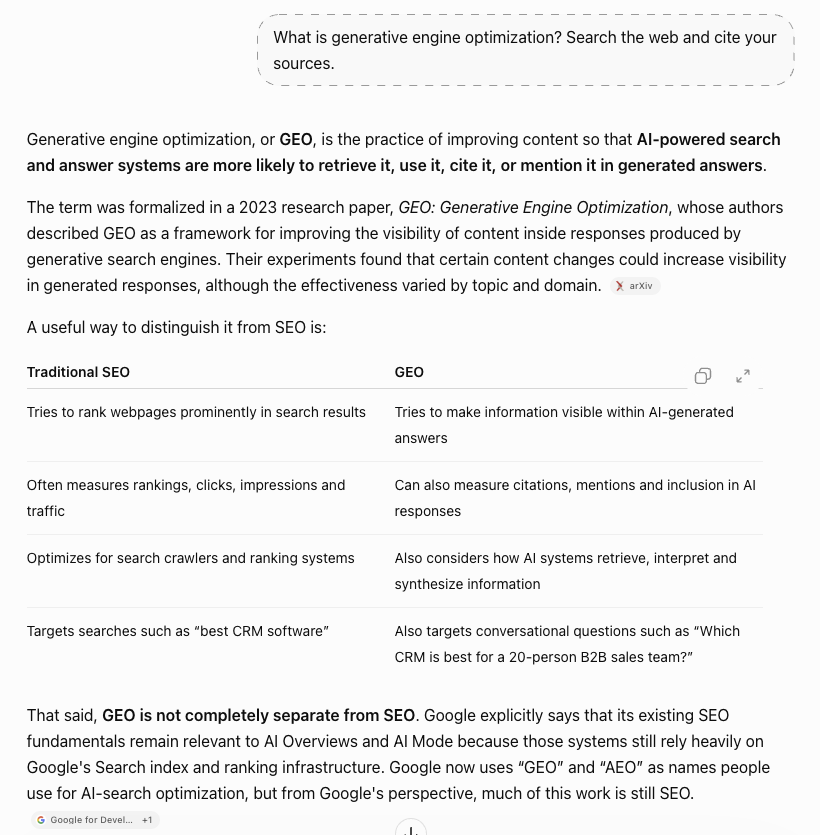
In a study of US searches in 2025, researchers repeated searches two months later. Only 18% of AI Overview pages appeared in both runs, against 45% of Google’s organic results (Findings of ACL 2026). Because AI Overview links changed more than organic results in that study, we check the links each month.
OpenAI does not list a Google ranking as a requirement for ChatGPT search. Its OAI-SearchBot surfaces sites in ChatGPT search. OpenAI says sites opted out of it “will not be shown in ChatGPT search answers”, though they “can still appear as navigational links”. Researchers also compared Gemini and OpenAI’s search model with Google’s organic results. Both had less overlap than Google’s AI Overviews did (Findings of ACL 2026).
No. Google says separate pages for related queries can violate its scaled content abuse policy when made mainly to manipulate results. Answer the main question and related questions on one useful page. Give each answer its own heading.
Google says structured data is not required for its AI features, and no special markup is needed. It still matters in ordinary search. Google uses it to understand a page and can show details such as price, ratings and opening hours in search results. Microsoft says schema helps search engines and AI systems understand content. Google asks that markup match the visible page, so keep it true.
You can write these ten checks into Tandra, our AI workspace. Its agents can follow them when they draft each page.
We check whether ChatGPT and Google AI Overviews name your brand, then send you the report. It costs nothing.
Get my free GEO check